Michael Morabito
October 28, 2026
The most common step and repeat banner size is 8 feet tall by 8 feet wide, which fits two or three people in a full-length photo. For groups of four, choose 8′ × 10′. For groups of five or more, red carpets, and press walls, go 12 feet wide or more. A simple rule: allow about 2 feet of width for each person who will stand in the photo, plus about 2 feet so the edges of the backdrop stay out of the shot. Keep the height at 8 feet for full-length photos, check that your ceiling clears the stand, and choose a matte finish so camera flash doesn’t cause glare. Unique Print NY at 242 West 36th Street, New York, NY 10018 prints step and repeat banners in vinyl and fabric. Call (212) 420-9198 Monday–Friday 9AM–5PM.
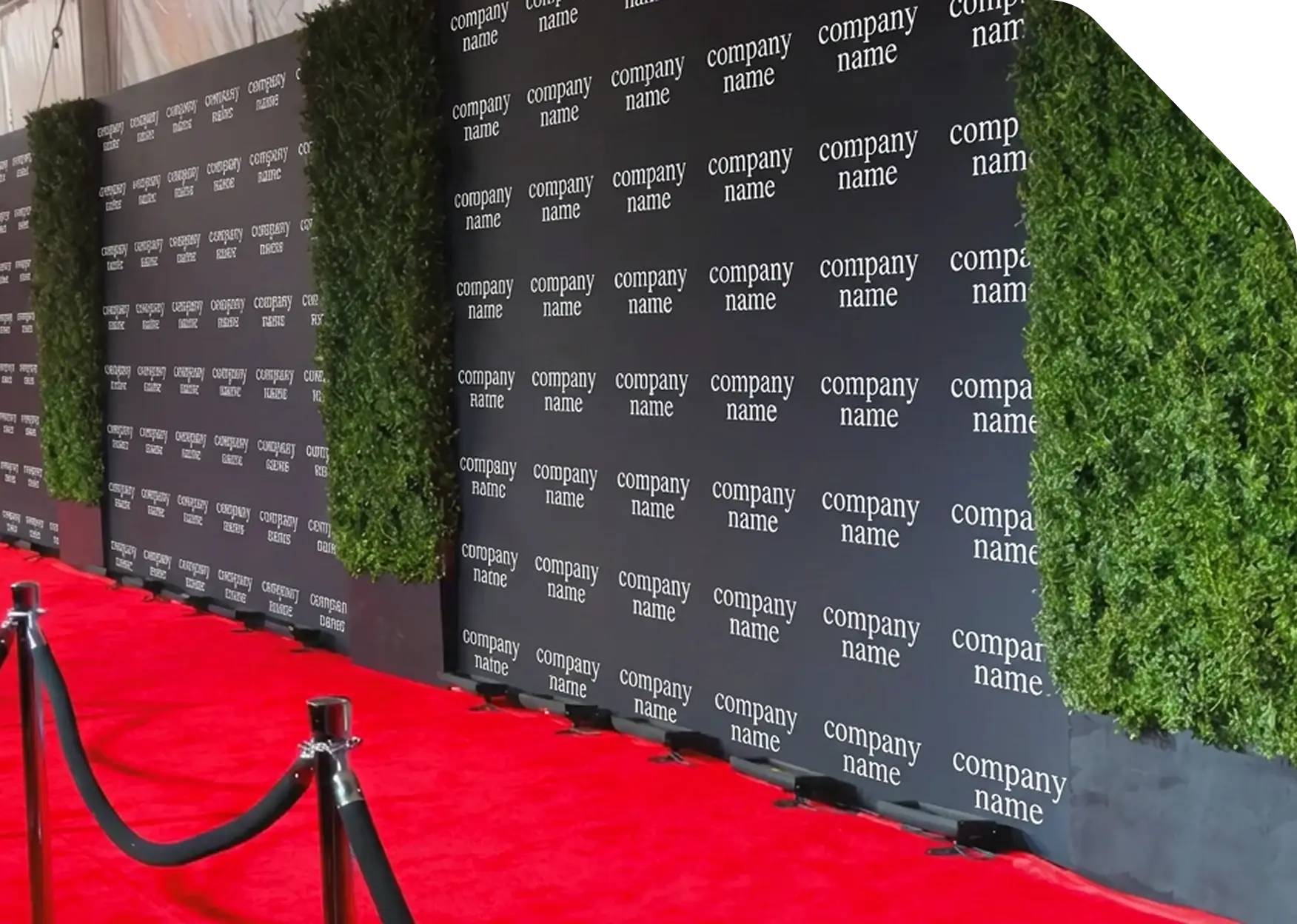
A step and repeat is the logo-patterned backdrop guests pose in front of at galas, launches, premieres, fundraisers, and trade show booths. It earns its cost in every photo that gets posted afterward, but only if it is the right size. Too narrow and a group shot spills past the edges, so the photos show a bare wall on both sides. Too tall for the room and it won’t stand up under the ceiling. Too glossy and every flash photo has a white hot spot across the logos.
This guide covers how to choose the right size for your event: the standard sizes and who each one fits, how to measure your space, how big the logos should be, and which material to choose. When you’re ready to order, see our step and repeat banner printing page for options.
Standard Step and Repeat Sizes
Height is usually fixed at 8 feet, which leaves enough room above even tall guests for a full-length photo. Width is the decision that matters. Here is how the common sizes compare:
| Size (H × W) | People in Frame | Best For | Good to Know |
|---|---|---|---|
| 8′ × 8′ ★ | 2–3 | Most events: launches, birthdays, fundraisers, brand activations, trade show booths | The standard size. Fits most rooms and is the easiest to transport and set up |
| 8′ × 10′ | Up to 4 | Corporate events, award nights, sponsor walls, couples plus family | The best choice if groups of four will pose together regularly |
| 8′ × 12′ and wider | 5+ | Galas, premieres, red carpets, press walls with several photographers | Quoted as a custom size. Confirm wall length and how it will get into the venue |
| Under 8′ wide | 1–2 | Tight rooms, small booths, headshot or single-subject setups | Quoted as a custom size. Works when shots are mostly waist-up |
The most common step and repeat mistake is ordering too narrow. People drift toward the edges, groups grow, and photographers step back for a wider shot. A backdrop that’s 2 feet wider than you think you need costs far less than a night of photos that show bare wall at the sides.
How to Choose the Right Size for Your Event
Five measurements decide the size. Work through them before you request a quote, and send them along with it.
-
Count the largest group that will pose together
Allow about 2 feet of width per person, then add about 2 feet so the photographer has room at the edges. Two to three people need roughly 6 to 8 feet; four to five need 10 to 12 feet. Size for the biggest group you expect, such as the honorees, the sponsors, or the whole team, not the typical pair. -
Decide how photos will be framed
Full-length red carpet shots need the full 8-foot height and more width, because the photographer stands farther back and the frame takes in more of the backdrop. If most photos will be waist-up or head-and-shoulders, a narrower backdrop can work, because the frame is filled by the people rather than the backdrop. -
Measure the wall and floor space
Measure the space the backdrop will stand in, and leave extra room on each side for the stand’s feet and for people to walk on and off. Also leave room in front: the photographer usually stands several feet back, and guests need a clear space to pose. A step and repeat placed in a narrow hallway or tight entry will cause a line. -
Check the ceiling height
An 8-foot backdrop on a stand needs a little more than 8 feet of clear height for the top bar. Many NYC venues, lofts, and restaurant private rooms have low ceilings, soffits, sprinkler heads, or hanging lights that get in the way. If the ceiling is tight, measure the lowest point where the backdrop will stand, not the average height of the room. -
Plan how it gets into the building
In Manhattan, getting the backdrop into the venue is often harder than putting it up. A rolled 8-foot vinyl backdrop needs a car, cab, or elevator that fits an 8-foot tube. Fabric folds into a much smaller bag. If the venue has a small elevator or a walk-up, ask about fabric, and confirm the venue’s load-in rules before the event.
How Big Should the Logos Be?
The repeating pattern is what makes a step and repeat recognizable in photos. Get the logo size and spacing right and the brand appears in every shot, whether the photographer frames a full-length group or a close-up of two people.
Readable in Every Crop
Logos roughly 12 to 18 inches wide work well on a standard 8′ × 8′ backdrop. That’s large enough to read in a full-length photo, and small enough that at least one full logo appears beside each person’s head in a close crop. Very large logos often end up cut off or hidden behind people.
The Standard Layout
Offset each row by half a logo, like brickwork, rather than stacking logos in straight columns. The staggered pattern fills gaps more evenly, so a logo shows up near every person, whatever their height or wherever they stand.
Host + Sponsor
For co-branded events, alternate the host logo and the sponsor logo in a checkerboard. Keep both logos the same visual weight so neither one dominates. With three or more sponsors, a step and repeat gets busy quickly, so consider a larger backdrop.
Where the Camera Looks
The part of the backdrop that shows in most photos is the zone around guests’ heads and shoulders, roughly 4 to 7 feet off the floor. Make sure that band has full, unbroken logos. The bottom of the backdrop is usually hidden by legs, bags, and dresses.
Simple Marks Read Best
Taglines, URLs, and thin lines disappear in photos and on phone screens. Use the simplest version of each logo, often the icon or wordmark, rather than a full lockup with small text underneath.
Flattering in Photos
White or a light brand color behind the logos is the classic choice. It lights evenly and keeps skin tones natural. Dark backgrounds can look dramatic, but they need more light and are less forgiving with flash.
Vinyl or Fabric: Which Material to Choose
| Material | Look in Photos | Transport & Setup | Best For |
|---|---|---|---|
| Matte vinyl (13 oz) | Sharp, saturated color; matte finish keeps flash glare down | Rolls in a tube; durable and wipeable | One-off events, outdoor use, budget-conscious orders |
| Heavy-duty vinyl (18 oz) | Same print quality, stiffer and more substantial | Heavier; rolls in a tube | Backdrops used at many events over a long period |
| Fabric (wrinkle-resistant polyester) | Soft, premium look with no shine at all | Folds into a bag; easiest to carry through Manhattan | Galas, corporate events, brands that reuse the backdrop, venues with tight access |
Avoid Flash Glare
Event photos are mostly taken with on-camera flash. On a glossy backdrop, the flash bounces straight back into the lens and leaves a bright white patch behind the people in the photo, often right across a logo. A matte vinyl or fabric surface scatters the light instead, so logos stay readable and the background stays even. For a step and repeat, choose matte unless you have a specific reason not to.
Fabric: no shine, folds small
Gloss: avoid for flash photography
Finishing depends on how the backdrop will hang. Grommets suit backdrops hung from a frame or wall with ties or hooks, and pole pockets suit backdrops that slide onto a stand’s crossbar. Tell us how you plan to display it when you request a quote. Our guide to banner printing materials covers vinyl weights and fabric in more detail.
File Setup and Ordering
Print-Ready Checklist
Vector logos. Send logos as vector files (AI, EPS, SVG, or a vector PDF) so they print sharp at any size. A logo copied from a website will look blurry at 8 feet.
A print-ready PDF at the final size, or at an exact scale. Large format files are often built at a proportional scale, such as 1:10, to keep file sizes manageable. Tell us the scale and the finished size. Use CMYK color and include any brand color references you need matched.
Finishing allowance. Grommets and pole pockets use some of the edge of the backdrop. Ask for the exact dimensions and margins before you build the file, so logos aren’t cut off or hidden in a pocket.
Your event date. Allow about a week from proof approval for standard production. Rush production is available at an added charge. Call (212) 420-9198 to confirm timing for your date.
Our print guidelines and PDF checklist for commercial printing cover file preparation step by step.
Planning more than a backdrop? Step and repeats are often ordered with banners and other trade show printing. Our trade show printing guide covers the full exhibitor checklist.
Frequently Asked Questions
Step and Repeat Banners Printed in Midtown Manhattan
Matte vinyl or fabric, standard 8′ × 8′ and 8′ × 10′ or custom sizes, finished with grommets or pole pockets. Printing in New York since 1977. Pickup at our shop on West 36th Street, a short walk from Penn Station.
242 West 36th Street, New York, NY 10018 · (212) 420-9198 · Mon–Fri 9AM–5PM · Minimum order $175
Michael Morabito
October 28, 2026